


Logistics
Routes, resources, inventory, and timing all affect each other. We build the algorithms to make sense of it all – to make every move count.
Optimisation behind every move
Better planning and automation across warehouses and fleets help orders ship faster and at lower cost, using fewer resources and making operations more resilient to disruptions.
We build algorithms and software that integrate with your ERP and operational systems, helping your logistics team make better decisions without replacing everything around them. Digisalix helps with:

Enjoy efficiency?
Would you like to optimize your logistics operations? Let’s figure it out.

Route and fleet optimisation
Planning, simulation, and the replanning that follows
Moving vehicles efficiently gets complicated quickly. Routes, schedules, vehicle capacity, delivery windows, resource availability, and changing conditions all affect each other. Optimising one part in isolation can simply move the problem somewhere else.
We build algorithms and software for planning, simulating, and managing fleets as a whole. Depending on the operation, that means:
Optimising routes, schedules, and vehicle utilisation
Coordinating vehicles, drivers, equipment, and other operational resources
Replanning when demand, availability, or operating conditions change
Simulating fleet configurations and operational scenarios before committing to investments
Giving operators a clear view of what is happening now, and what should happen next
Simulation also answers a bigger question: what should the fleet look like in the first place? We have simulated fleet designs and demonstrated the production gains before the equipment was bought.
Once the plan meets reality, optimisation becomes a continuous job. Vehicles get delayed, priorities change, resources become unavailable, and new orders arrive. The software should absorb those changes rather than leave an operator to untangle the whole plan by hand every time.
Algorithms are at the core, but the result still has to be usable. We build the full stack, from optimisation and simulation to integrations and operator interfaces, so complex planning ends up as decisions people can act on.
A good plan survives contact with the real world.
Digital warehouse automation
Robots, placement, picking and packing
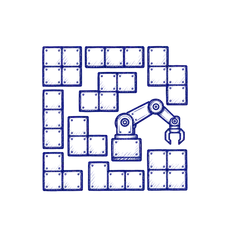
Warehouse automation covers much more than moving robots from A to B. It includes robot fleet management, demand forecasting, inventory and resource planning, product placement optimisation, and packing planning. These problems are closely connected: where products are stored affects picking time, picking affects robot movement, and demand affects what needs to be available.
Getting these decisions right helps warehouses fulfil orders faster, use resources more efficiently, and remain robust when conditions change. We have implemented algorithms, for example, to help robots fetch items faster and to plan pallet packing, with solutions integrated into ERP systems.
Good warehouse automation is not about automating everything. It is about making the whole operation work better.
Inventory and resource planning
The right level, with the uncertainty accounted for
Inventory, storage, and other operational resources can tie up substantial amounts of capital. The challenge is finding the right balance: planning everything around maximum demand is expensive, while shortages and insufficient capacity quickly disrupt operations.
Demand changes. So do material availability, energy costs, transport capacity, and other operating conditions. Good planning accounts for uncertainty rather than assuming tomorrow will behave exactly as the spreadsheet says it will.
Digisalix combines optimisation and data science to:
Match purchasing, production, capacity, and other resource decisions to demand forecasts and market costs
Organise product and item placement for efficient warehouse operations
Plan inventory levels while accounting for demand and supply uncertainty
Monitor operations and conditions to detect anomalies or changes that require action
Inventory and resources are necessary for the final product, but they are not the final product. Don’t let them eat all the investment.
Algorithms that fit the operation
There is no need for a complete overhaul of your systems. We improve individual parts of the current solution or redesign the algorithmic core where necessary, while integrating the result into your existing workflow.
Our focus is on the difficult algorithmic problems: optimisation, planning, simulation, and data-driven decision-making. Where the job requires it, we also build the surrounding software, integrations, and user interfaces to turn those algorithms into a complete working tool.