SIX Mobile Work Machines (SIX MWM) is an industry & research cluster with the aim of making Finland the best place for mobile work machine development. They held the yearly results seminar a couple of weeks ago, and Digisalix, a proud partner, was there too. Here are some highlights from the meeting.
At the beginning of the year, SIX MWM and FIMA (Finnish Mobile Work Machine Association) merged to form Finland’s largest cluster for mobile work machines. They continue under the SIX MWM title, to drive joint innovation, top-level research, and talent education towards making the Finnish mobile work machines industry the best in the world. One large ongoing initiative is the Centre of Research and Education Excellence (CORE) competence center. It aims to strengthen the work of VTT and five Finnish universities in the domain, including talent education and research.
Faster and safer operations with assistive control
While many autonomous solutions require tedious human supervision of action, assistive control aims at combining human intention and autonomous decision making. Assistive control can also be easier to deploy robustly in the short term, while full autonomy remains the long-term goal. Ville Kyrki, professor at Aalto University, presented research in constraint-aware assistive control.
In their research, they developed a method for ensuring safety while minimizing the deviation from operator’s input. One highlight of the study was comparing assistive control and pure user control with 66 participants navigating with a simulated robot. They found that assistive control allowed the users to complete tasks faster, with decreased mental load, high perceived trust, and without users feeling loss of control.
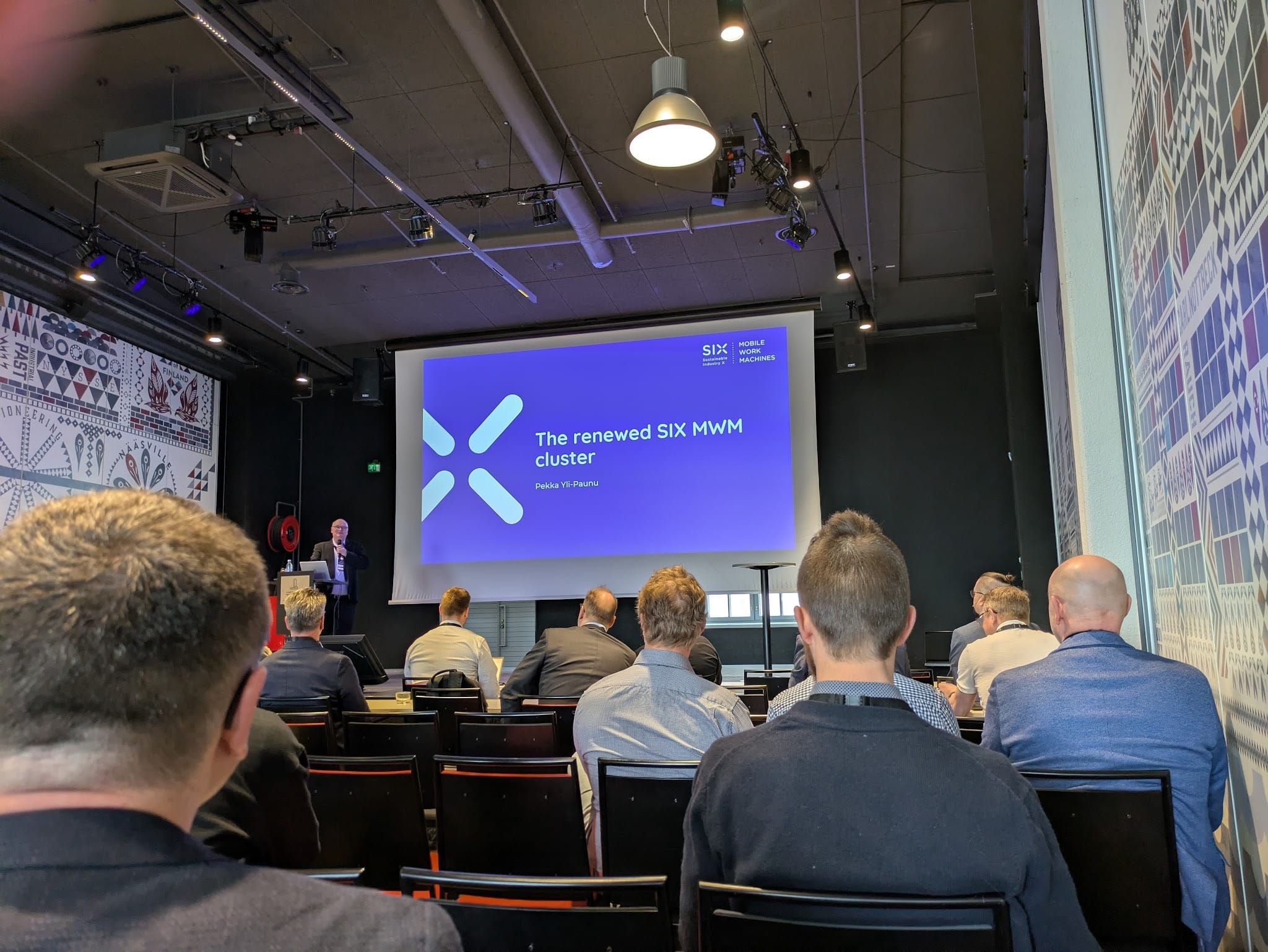
Mixed fleets: humans and machines communicating
Tampere university doctoral researchers Aparajita Chowdhury and Hamza Haoui presented their research in mixed fleet operation, that is, humans, human operated machines, and autonomous machines collaborating in the same work area. Firstly, their research considered human factors related to mixed fleet cases. Humans are the most important participants from a safety and comfort perspective but at the same time also the most unpredictable part of the fleet. Secondly, they explored how large language models could help humans organize the work more efficiently. For example, large language models can translate natural language goals to formal plans. Then the formal plans can be verified and validated in simulations before executing them in the real world.
Digisalix 💚 SIX MWM
SIX MWM’s goals of making the machines more sustainable, safe, and intelligent require solving hairy optimisation tasks, finding the signal in a data hay stack, while keeping the human user in control of it all. This sounds like a perfect match for Digisalix. We’d be delighted to learn of new challenges we could solve. Please, get in touch if you know of one.